Across France, thousands of homeowners live with the same frustration:
their beautiful older homes are freezing in winter, overheating in the warmer months, and expensive to run all year round.
Oil boilers cost a fortune.
A single wood burner barely heats one room.
Upstairs bedrooms become uncomfortably hot as soon as the weather warms.
Plug‑in radiators help temporarily, but never solve the problem.
If this sounds familiar, you’re not alone — and you’re not imagining it.
Older French homes were never designed for modern comfort.
But today, new renovation technologies and smarter building strategies make it possible to transform these homes completely, without losing their charm.
Why Older French Homes Struggle With Temperature Control
Traditional French homes — stone farmhouses, longères, village houses, manoirs, barns, cottages, and rural properties — were built using natural materials that behave very differently from modern construction.
Common issues include:
- Heat escaping through uninsulated roofs
- Stone or block walls that feel cold and damp
- Outdated oil or electric heating systems
- Poor ventilation that traps humidity
- Rooms that overheat because the roof absorbs too much sun
- Windows and shutters that no longer perform properly
The result is the classic problem:
Cold downstairs, hot upstairs, and high bills everywhere.
But these problems are not permanent — they simply require the right renovation approach.
The Modern Solutions That Are Transforming Older French Homes
Here are the technologies and renovation strategies most homeowners don’t know about — but that make the biggest difference.
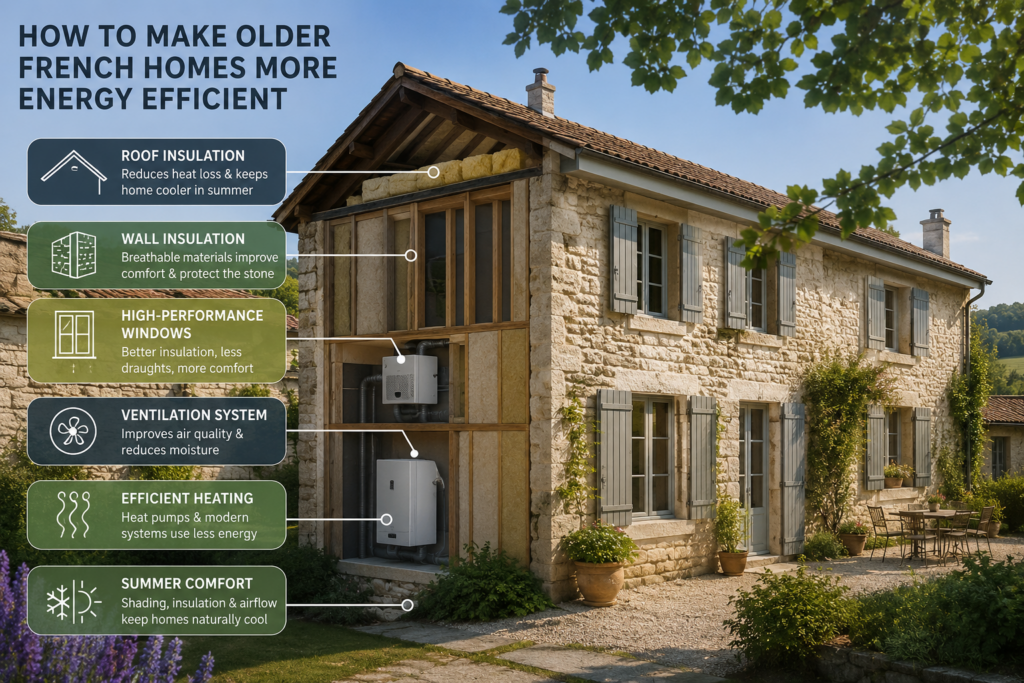
1. High‑Performance Roof Insulation (Winter + Summer Protection)
Up to 30% of heat loss happens through the roof.
But what most people don’t realise is that the roof is also the main source of summer overheating.
Modern insulation materials such as:
- Wood fibre
- Hemp
- Multi‑layer reflective insulation
- Breathable natural systems
don’t just keep heat in during winter — they also block heat from entering during the warmer months.
Results:
- Warmer bedrooms in winter
- Cooler upstairs in summer
- Lower heating bills
- Immediate comfort improvement
For many homes, this is the single most effective upgrade.
2. Breathable Wall Insulation That Protects the Building
Older homes must be able to breathe.
When synthetic insulation or plasterboard is added, moisture gets trapped — leading to damp, mould, and cold walls.
Modern breathable systems use:
- Wood fibre panels
- Cork insulation
- Hemp‑lime mixes
- Lime‑based renders
These materials improve thermal performance while allowing the building to regulate humidity naturally.
Results:
- Warmer walls
- Less condensation
- A more stable indoor temperature
- A healthier building long‑term
3. Heat Pumps Designed for Older Homes (Yes, They Work Now)
Most homeowners believe heat pumps only work in modern houses.
That used to be true — but not anymore.
High‑temperature heat pumps can now replace oil boilers without changing your radiators.
They heat water up to 70°C and remain efficient even in cold climates.
Results:
- Much cheaper to run than oil
- No fuel deliveries
- Quiet, reliable heating
- Works perfectly with older stone or block homes when installed correctly
4. Hybrid Heating Systems — A Practical Upgrade for Older Homes
If a full heat pump isn’t suitable, hybrid systems combine:
- A heat pump for most of the year
- Your existing boiler for extreme cold snaps
This gives you comfort, efficiency, and reliability — without a full system replacement.
5. Modern Wood & Pellet Systems That Heat the Whole House
A single fireplace cannot heat a large home.
But modern systems can:
- Ducted wood‑burning stoves
- Pellet boilers with automatic feeding
- Whole‑house distribution systems
These deliver heat evenly throughout the home, not just in one room.
Results:
- Consistent warmth
- Lower running costs
- A renewable, sustainable heating option
6. Smart Ventilation That Removes Heat in the Warmer Months
Ventilation is the most overlooked part of older homes.
Modern systems can:
- Extract hot air from upstairs
- Bring in cooler night air
- Reduce humidity
- Improve air quality
- Prevent mould
This alone can reduce upstairs temperatures by several degrees.
7. Exterior Shading & Solar Control
Older homes often overheat because of direct sunlight on windows and roofs.
Modern shading solutions include:
- Discreet exterior blinds
- Solar‑control window films
- Roof overhangs
- Shutters designed for heat protection
These reduce heat gain without altering the character of the property.
What Most Homeowners Don’t Realise
Many people assume the solution is:
- new windows
- a bigger boiler
- more radiators
- air conditioning
But the truth is:
Comfort comes from the building envelope — not the heating system.
Once the home is insulated and ventilated correctly, the heating system becomes smaller, cheaper, and far more efficient.
What Renova8 Does Differently
Renovating older French homes — whether built in 1750, 1850, 1950, or 1990 — requires experience, technical understanding, and respect for the building.
As a renovation and construction company, we:
- Analyse how the building behaves
- Identify the upgrades that will make the biggest impact
- Use materials suited to traditional French homes
- Design heating and cooling solutions that actually work
- Protect the character of the property
- Manage the entire renovation from start to finish
Our goal is simple:
to make older homes genuinely comfortable all year round.
Where to Start — A Clear Path for Homeowners
Step 1 — Thermal Assessment
Identify where heat is lost and where overheating begins.
Step 2 — Roof & Wall Strategy
Choose the right insulation for your building type.
Step 3 — Ventilation Plan
Ensure the home breathes correctly.
Step 4 — Heating Upgrade
Select the right modern system (heat pump, hybrid, pellet, underfloor).
Step 5 — Summer Comfort Solutions
Shading, airflow, and thermal mass management.
Step 6 — Full Renovation Plan
A clear roadmap with costs, phases, and priorities.
Want a Home That’s Warm in Winter and Cool in Summer?
If your older French home is uncomfortable, expensive to heat, or impossible to cool, you don’t need guesswork — you need a renovation plan designed for traditional buildings.
Renova8 specialises in transforming older homes into comfortable, efficient, modern living spaces without losing their charm.